> ## Documentation Index
> Fetch the complete documentation index at: https://support.webcentral.au/llms.txt
> Use this file to discover all available pages before exploring further.
# Registrant VS Registrant Contact
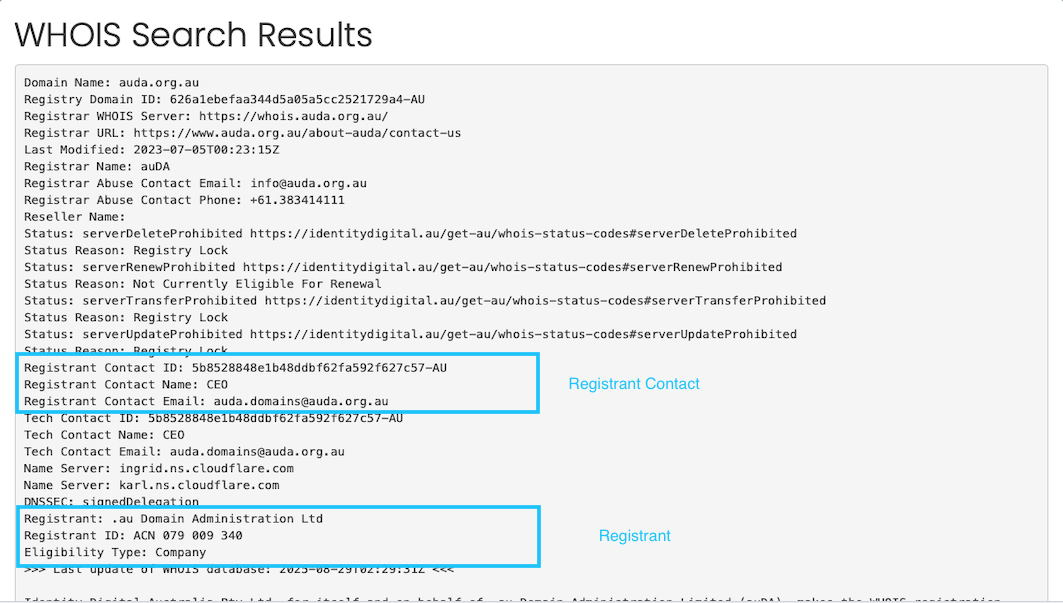
When you register a domain name, two roles are usually recorded:
### Registrant (Entity)
* The entity that the domain name is registered to
* Can be an individual, business, or organization
**IMPORTANT**: As there is different eligibility requirements based on your TLD, please be advised of the criteria that must be met below;
* com.au/net.au - the registrant must have an Australian presence and be a commercial entity.
* org.au - the registrant must be a not-for-profit organisation.
* asn.au - the registrant must have an Australian presence and be a not-for-profit entity or unincorporated association.
* id.au - the registrant must have an Australian presence and be a natural person – that means an individual person, **not** a company or organisation
* .au - The registrant must have a verifiable Australian presence, which includes being a citizen or permanent resident or an organisation registered in Australia.
* Responsible for the domain’s lifecycle, including fees, renewals, and eligibility details
### Registrant Contact
* The person or team appointed by the registrant to manage registration details
* Serves as the point of communication with the registrar
* Updates technical and administrative information, such as DNS or contact details
Here is what it looks like in action on a WHOIS lookup of a domain:
For help changing the entity (ABN/ACN) attached to your .AU domain, please see the article [Changing ownership of .au domain names/Change of Registrant (COR)](/domains/au-domains-and-cctlds/changing-ownership-of-au-domain-names)